
Why the most sophisticated interiors are moving away from brightness and towards contrast, shadow and carefully controlled light.
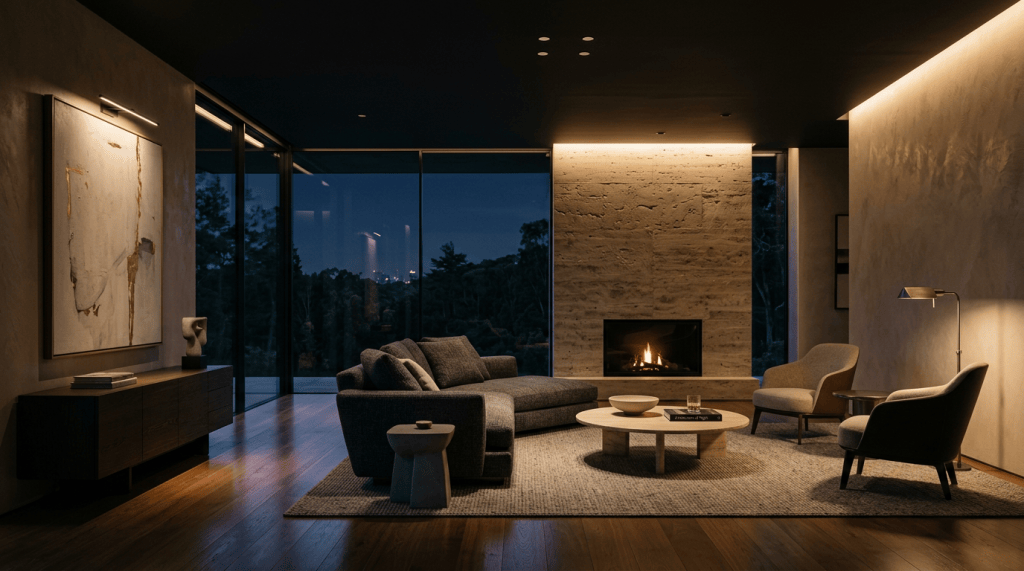
For a long time, good lighting was associated with brightness.
A well-lit room was often understood to mean a room where everything could be seen clearly. More downlights, higher light levels and fewer dark areas seemed like the safe approach.But some of the most sophisticated interiors today are moving in almost the opposite direction.They are becoming quieter.Ceilings are cleaner. Light sources are less visible. Certain surfaces are deliberately allowed to fall into shadow, while artwork, textures, furniture and architectural details are carefully revealed.The result is not a darker space for the sake of being dramatic. It is a space with hierarchy.And perhaps this is where the idea of luxury lighting is changing.
Luxury is no longer about how much light we add. It is about how precisely we decide where light belongs.
We Have Been Over-Lighting Our Interiors
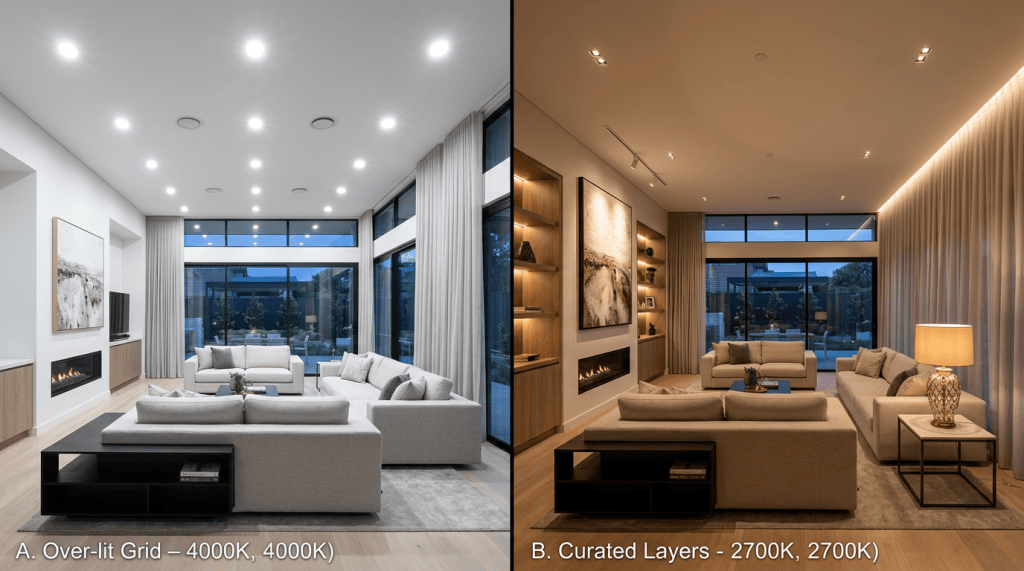
More light does not necessarily mean better light. When everything is illuminated equally, architecture loses depth, hierarchy and focus
Walk into many new homes and one feature still appears again and again: the regular grid of recessed downlights. Every metre or so, another light.The intention is understandable. If every part of the room is illuminated, surely the lighting must be working. But uniform illumination can also remove one of the most powerful qualities that light gives architecture: depth.When the floor, walls, ceiling, furniture and circulation areas are all illuminated to a similar level, the eye has very little guidance. Everything becomes equally important — and therefore, visually, nothing is particularly important.Interestingly, current luxury-residential research is showing the same shift. Lutron’s 2026 trend research describes designers moving away from uniform downlight grids and towards warmer, layered and more dynamic lighting that changes according to activity and time of day.
That change is significant. It means the question is slowly moving from:
“How do we light this room?”
to:
“What do we want people to notice in this room?”
And those are two very different approaches.
Darkness Is Part of the Lighting Design
One of the most useful lessons in architectural lighting is surprisingly simple:
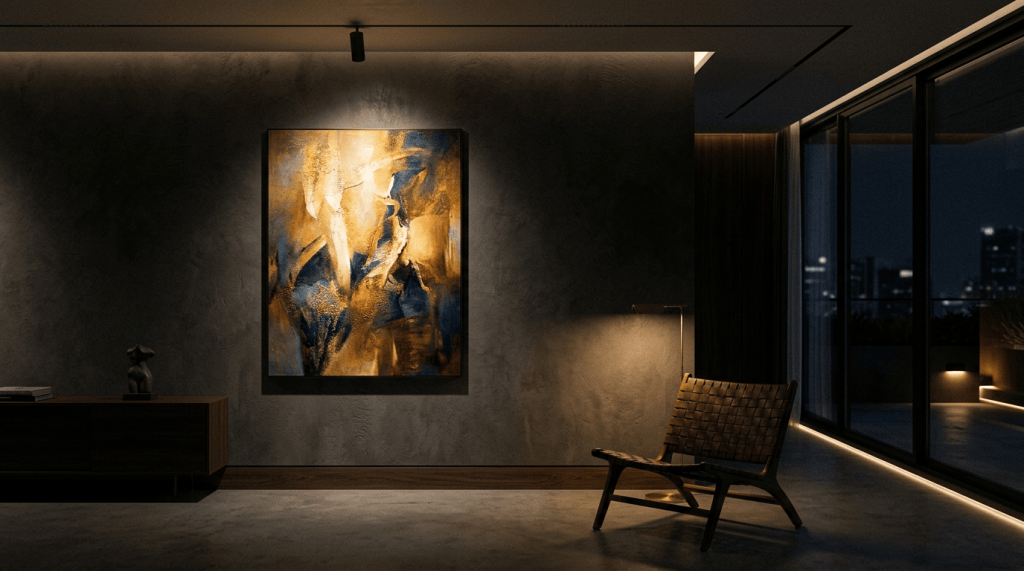
You need darkness to see light.
Think about a beautifully lit piece of artwork.
If the wall around it is already extremely bright, increasing the light on the artwork has limited impact. But allow the surrounding environment to become slightly darker and suddenly the artwork has presence.
The same principle works with architecture.A textured stone wall revealed by grazing light becomes more three-dimensional because highlights sit beside shadow. A tree illuminated against a darker garden becomes a focal point.A dining table surrounded by softer ambient light feels intimate because the pool of light creates its own visual territory.A staircase with subtle low-level illumination can appear more elegant than one flooded from the ceiling.This is why shadow should not always be treated as a lighting problem.Sometimes shadow is the thing that makes the lighting work.The objective is not to create uncontrolled darkness. It is to create a carefully balanced relationship between illuminated and non-illuminated surfaces.Light reveals.Shadow gives what has been revealed its importance.
Stop Lighting the Room. Start Lighting the Architecture.
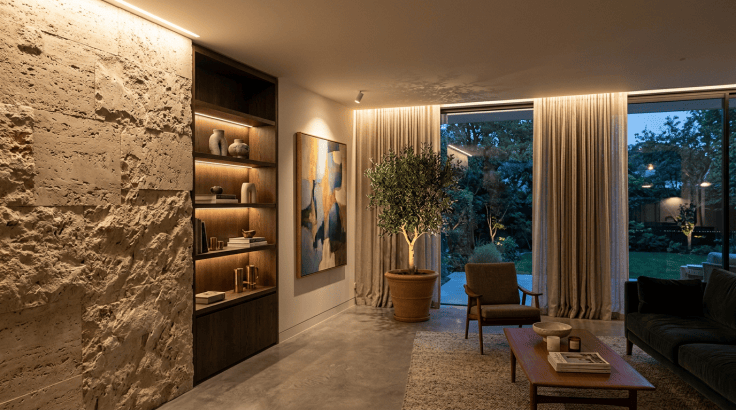
This is where lighting becomes much more interesting. Instead of beginning with fixtures, begin with materials and objects.
What is the stone like?
Is there artwork?
Are the curtains textured?
Is the joinery worth revealing?
Where will people sit?
What will they see when they enter?
What deserves attention first?
A rough stone or travertine surface can completely transform when light grazes across it.
Timber becomes warmer when it receives controlled directional light.
Artwork benefits from accurate colour rendering and precise accent lighting.
Curtains can become a soft vertical backdrop.
Shelving can gain depth from integrated light rather than another downlight positioned above it.
Plants can be illuminated from below, behind or across the foliage to produce very different impressions.
Lighting then stops being something that simply fills the room.
It begins to edit the architecture.
Light should tell the eye where to go.
The Ceiling Can Become Quiet Again
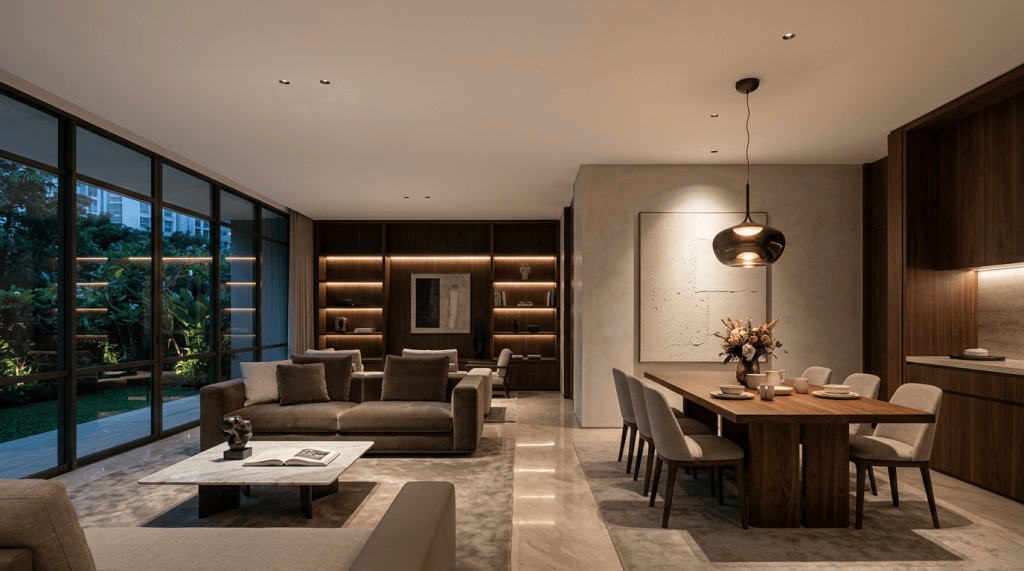
There is another benefit to this approach: fewer visible fixtures.
A beautiful ceiling does not necessarily need to demonstrate how many lighting calculations went into the room.
In many cases, the most refined schemes are the ones where you hardly notice the architectural luminaires at all.
Deep-recessed, low-glare downlights can provide carefully controlled accent light. Concealed linear lighting can reveal architectural lines. Decorative pendants and lamps can then become intentional objects rather than competing with a ceiling full of bright apertures.
The difference is subtle but important.
Good architectural lighting does not always ask to be looked at.
Often, its role is simply to make everything else look better.
And as fixtures become smaller, optics improve and control systems become more sophisticated, designers have greater freedom to separate the source of light from the effect of light.
That is an important evolution.
We should design the effect first.
The fixture comes later.
One Room Should Not Have One Lighting Condition
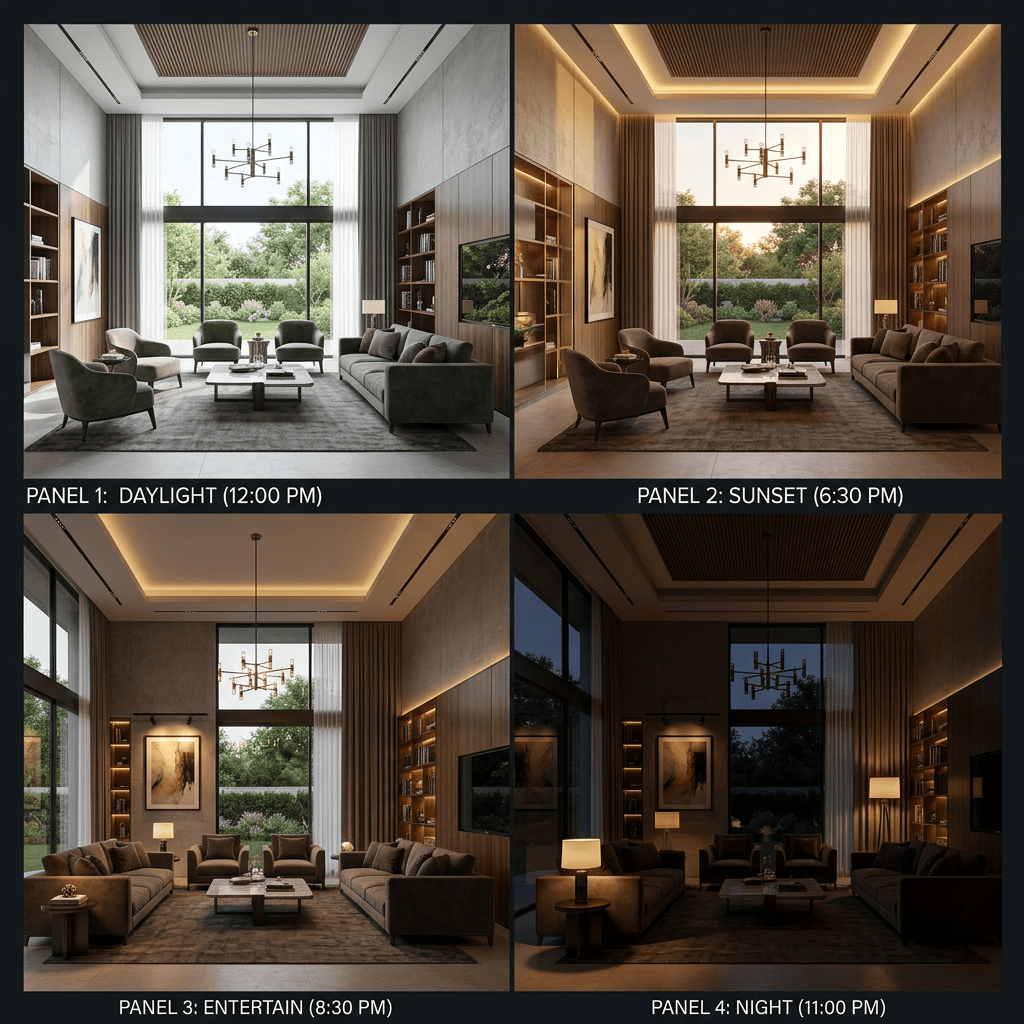
Another change happening in high-end residential lighting is the move away from static light.
A living room at 10:00 in the morning should not necessarily look the same at 8:00 in the evening.
During the day, daylight may be the dominant source. Architectural lighting can quietly support it.
At sunset, the balance changes.
Later in the evening, ceiling lighting can reduce while lamps, joinery lighting, artwork lighting and selected architectural accents become more prominent.
The architecture has not changed.
But the experience has.
Lutron’s recent research found that 60% of surveyed affluent US homeowners already adjust lighting according to mood or time of day, while interest in preset scenes substantially exceeds current adoption. The study surveyed 511 affluent American homeowners and 254 residential designers and architects, so it should be read as a US market indicator rather than a universal global figure.
This is where lighting controls become genuinely useful.
Not because controlling a light from a phone is particularly luxurious.
But because a carefully programmed scene can change dozens of individual lighting elements simultaneously and make the technology effectively disappear.
Entertain. Dinner. Relax. Night.
The user should not need to understand the lighting system.
They should simply experience the right atmosphere.
Perhaps Luxury Lighting Is Becoming Less Visible
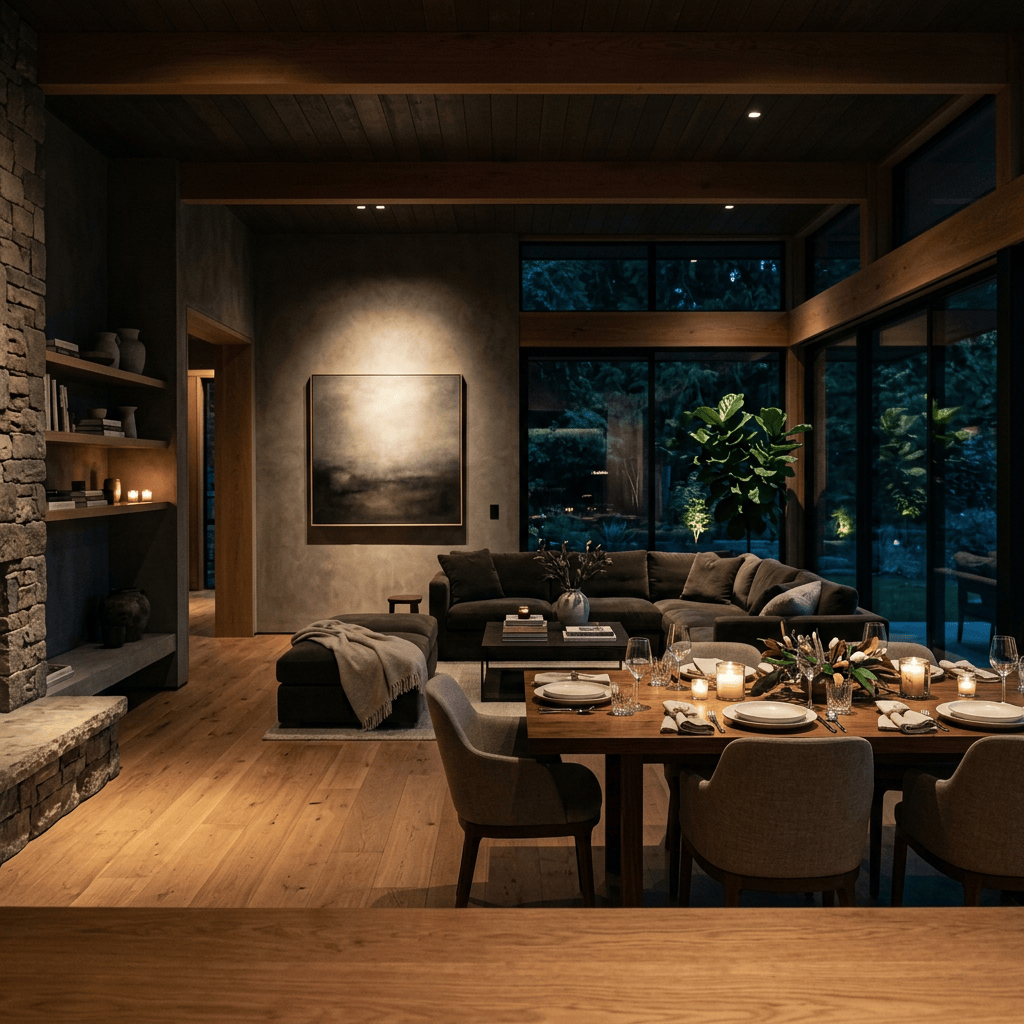
There is an interesting contradiction in good lighting design.
As lighting becomes more sophisticated, we may actually notice the equipment less.
We notice the texture of the stone.
The colour of the artwork.
The warmth of timber.
The reflection on a table.
The landscape outside.
The faces of the people around us.
We notice how the space feels.
And that may ultimately be the difference between simply illuminating architecture and designing with light.
The future of luxury lighting is unlikely to be defined by adding more fittings or producing more lumens.
It will be defined by restraint, precision, comfort, flexibility and contrast.By knowing which surface deserves light. Which object deserves attention. And equally importantly, which areas should quietly disappear.Because sometimes the most powerful lighting decision a designer can make is not deciding where to add another light.
It is deciding where not to add one.


Leave a comment